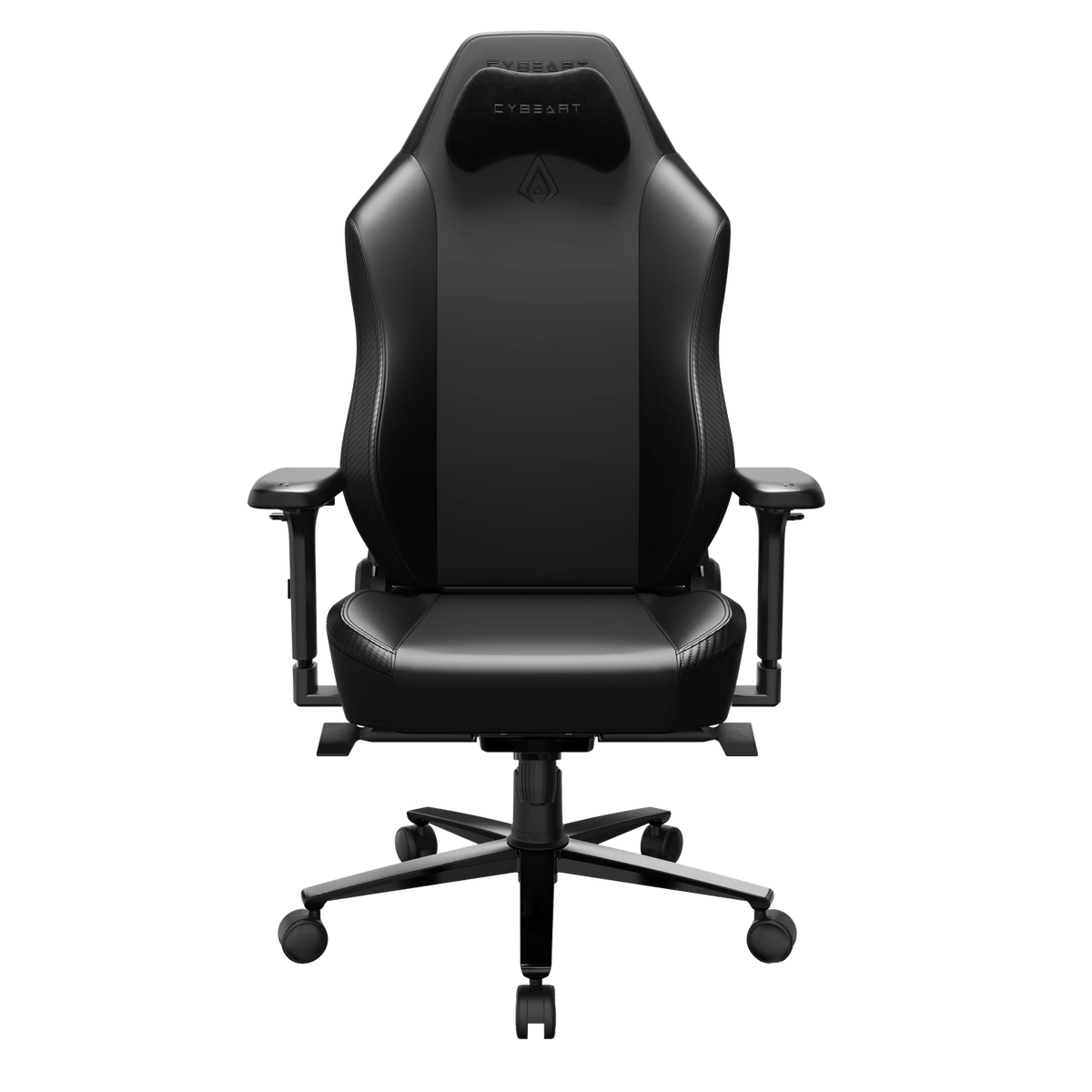
The five that count over a long day are support for your lower back, a seat at the right height, armrests that meet the desk, a recline you can change, and something for your neck to rest on. None of them helps unless the chair adjusts to you, so each point below comes with the real range on Cybeart's APEX and NEO chairs. The two share one frame and differ mainly in lumbar system, upholstery and base.
1. Lower-Back Support You Can Set
Your lower back curves inward, and a flat backrest leaves a gap there. Over a few hours you tend to slump into it. Good lumbar support fills that gap at the right height and depth.

APEX does this with ErgoSync™, a built-in 4D lumbar with two knobs. One moves the support up or down; the other sets how far it comes forward. NEO has a lumbar arch built into the backrest and comes with a memory-foam lumbar pillow, so you can add support or sit without it.
2. A Seat at the Right Height
Seat height sets everything else. Too low and your knees rise above your hips. Too high and your feet lose the floor. Aim for feet flat and thighs roughly level.

APEX and NEO sit 48 to 56 cm from floor to seat, with 8 cm of travel on a BIFMA certified Class 4 gas lift. The seat is 52 cm deep in use, and the chairs are sized for people from 5'5" to 6'4" (165 to 193 cm), rated to 330 lb (150 kg). Seat and backrest are high-density cold-cured moulded foam, firm enough to hold you where you set it.
3. Armrests That Meet the Desk
High armrests push your shoulders up. Low ones leave you leaning on one elbow. Either way, your neck and upper back take the load, which is why you want armrests you can bring level with the desk.

Both chairs have 4D armrests that move in height, width, depth and rotation. They rise 7 cm, from 67.5 to 75 cm off the floor, slide 4 cm forward or back and 2.5 cm sideways, and sit 45 to 50 cm apart. The tops are padded and concave, so your forearm rests in them rather than on an edge. On APEX they have a shadow chrome finish.
4. Recline and Tilt to Change Position
Even a good position gets tiring when you hold it for hours. Being able to change it through the day helps more than finding one perfect angle.

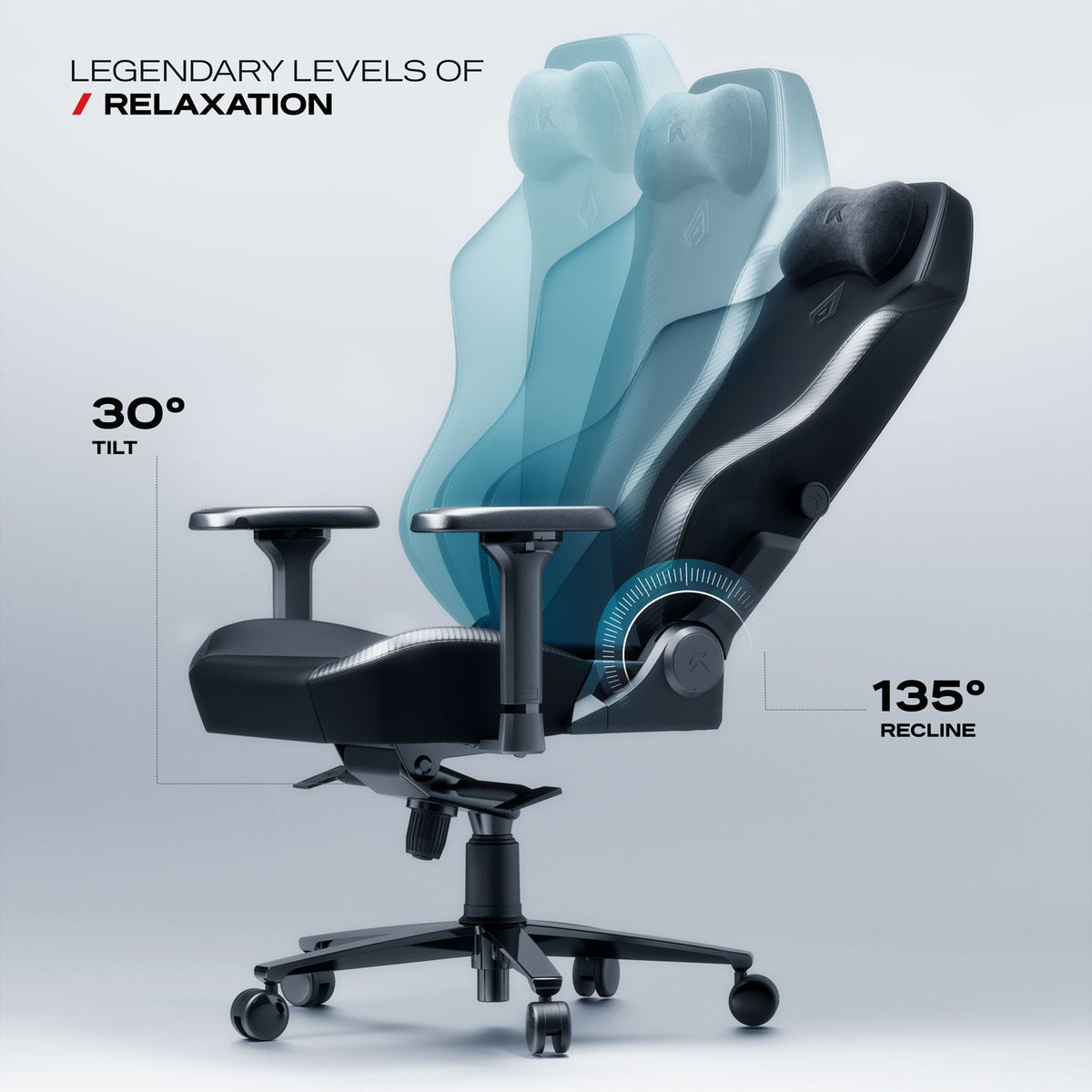
The multi-tilt mechanism on APEX and NEO is BIFMA certified. It reclines the back up to 135°, tilts the seat up to 30° and locks at more than one angle; on APEX the seat tilt is synchronised. Sit upright to type, lean back a little for a call or a cutscene, and lock it further back for a break.
5. Neck and Head Support
A tall backrest gives your shoulders and head something to rest against when you lean back, so you are not holding your head up yourself. On both chairs the backrest is 83 cm high and 56.5 cm wide.

The AeroMag™ neck pillow handles the fine-tuning. It is memory foam with a cooling gel, so it does not run warm, and magnets hold it to the backrest with no straps or clips. Your neck decides where it sits, not a strap, and it stays there once you have moved it.
Where APEX and NEO Differ
All five points apply to both platforms. The differences are in what covers the chair and what it stands on. APEX uses Endura™ Nappa leatherette, certified by TÜV SÜD past 1,000,000 abrasion cycles, on a die-cast aluminium base. NEO uses NeoTex™ leatherette, certified past 200,000 cycles, on a heavy-duty reinforced metal base. Both chairs are ANSI/BIFMA X5.1 certified, tested by SGS. The warranty differs too: APEX has 3 years, plus 2 more when the chair is registered with a review, and NEO has 1 year, plus 2 more with registration and a review.
One caution. A chair supports good posture; it does not replace getting up and moving, and ongoing pain is a question for a doctor. You can see each lumbar system up close on the APEX gaming chair and NEO gaming chair pages.